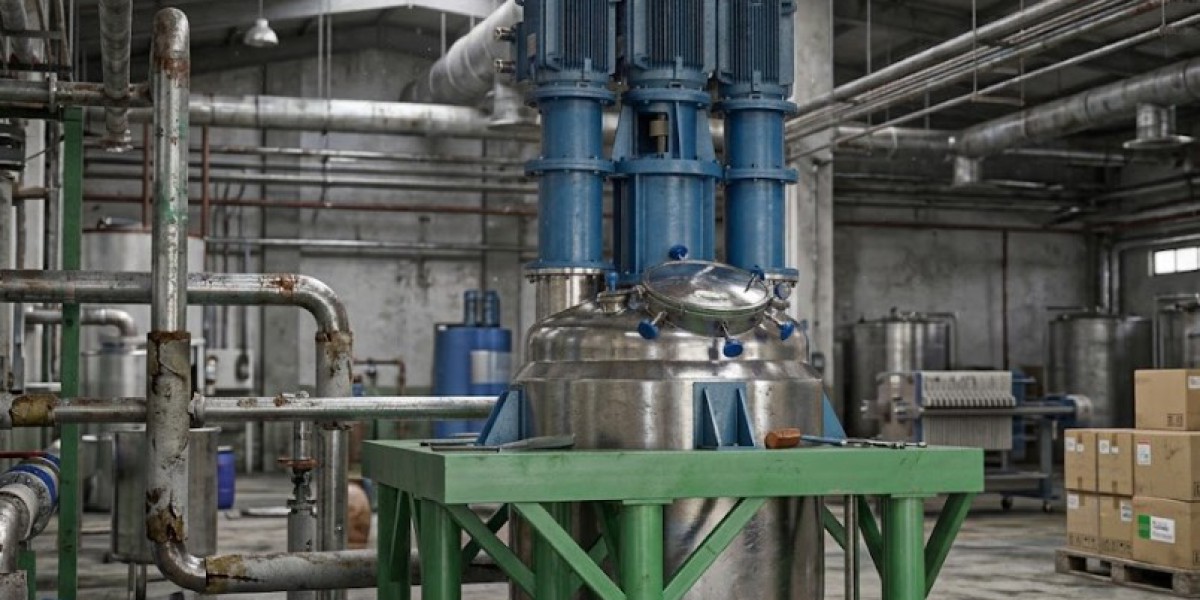
In many chemical and material industries, mixing is one of the first steps that determines the quality of the final product. If powders are not evenly distributed or particles form unwanted lumps, later production steps can become more difficult. This is especially common in coatings, pigments, chemical formulations, adhesives, and other high-viscosity materials.
A well-designed dispersing kettle can help manufacturers solve these problems. Instead of simply stirring materials together, it creates stronger and more controlled mixing conditions that help break up particles and produce a more even mixture.
For companies looking to improve batch consistency and production efficiency, choosing the right equipment can make a noticeable difference. Rucca provides dispersing equipment designed for different material properties, production capacities, and processing requirements.
Why Mixing Quality Matters
A simple mixer may be enough for low-viscosity liquids, but more difficult materials often need stronger mixing action. Powders can gather into small groups, pigments may not spread evenly, and thick materials can remain unmixed near the vessel wall.
These problems can affect the appearance, stability, and performance of the finished product.
For example, coating manufacturers may find that poorly dispersed pigments create uneven color. Chemical producers may experience separation during storage. Adhesive manufacturers may see differences in viscosity from one batch to another.
A suitable industrial dispersing kettle helps reduce these problems by improving how material moves inside the tank and how mixing energy reaches the product.
What Makes a Good Dispersing Kettle?
Several factors affect the performance of a dispersing kettle. The equipment should not only provide sufficient mixing power but also match the characteristics of the material.
1. Better Material Movement
The shape of the mixing vessel has an important effect on production results. Poor internal flow can leave some material sitting around the walls or bottom of the tank.
Rucca designs its chemical dispersing kettles with internal structures that help guide materials toward the main mixing area. This improves circulation and reduces areas where material can remain inactive.
Better circulation means that more of the batch receives similar mixing conditions, helping manufacturers achieve more consistent results.
2. Temperature Control
Some materials are sensitive to temperature changes during mixing. Others may produce heat because of the mixing process or chemical reaction.
A dispersing kettle can therefore be equipped with a jacketed heating or cooling system. Operators can control the temperature while the material is being processed.
This is useful for products that need to remain within a certain temperature range. Stable temperature conditions can also make production easier to repeat from one batch to the next.
3. Adjustable Mixing Speed
Not every material requires the same mixing speed.
Thin liquids may need relatively gentle mixing, while pigments, powders, and high-viscosity pastes may require stronger dispersion.
With adjustable drive systems, operators can change the mixing speed according to the material being processed. This gives manufacturers greater flexibility when one machine is used for several formulations.
Solving Common Production Problems
Industrial manufacturers often face similar dispersion problems. The right equipment can help address some of these issues at the source.
Uneven Pigment Distribution
When pigments are not properly dispersed, the finished coating may show inconsistent color or surface quality.
A high shear dispersing kettle provides stronger mixing action to help break apart pigment clusters and distribute them throughout the liquid or paste.
Air Bubbles in the Product
Some materials easily trap air during mixing. This can create bubbles and affect the appearance or performance of the final product.
For these applications, a vacuum dispersing kettle can be useful. Vacuum conditions can help remove trapped air while the material is being mixed.
This is particularly valuable for products where a smooth, bubble-free appearance is important.
Different Results Between Batches
Batch-to-batch variation is another common challenge. Even when the formula stays the same, changes in mixing speed, temperature, or processing time can produce different results.
Modern dispersing equipment can combine speed control, temperature management, and process monitoring. This allows operators to follow a more consistent production procedure.
Applications Across Different Industries
The flexibility of a dispersing kettle for industrial mixing makes it useful in many fields.
Coatings and paints:
Used to disperse pigments, fillers, and other ingredients to achieve a more uniform coating.
Chemical production:
Suitable for preparing chemical mixtures and formulations that require controlled dispersion.
Adhesives and sealants:
Useful for processing materials with higher viscosity where ordinary stirring may not provide enough mixing force.
Advanced materials:
Can be used when powders or fine particles need to be distributed evenly throughout a liquid or paste.
The actual equipment configuration should be selected according to the formulation, viscosity, batch size, and required production speed.
How Rucca Approaches Equipment Selection
Choosing a dispersing kettle should involve more than comparing tank capacity or motor power.
Rucca considers factors such as material characteristics, corrosion resistance, required temperature range, production volume, and mixing requirements when designing equipment.
For example, different stainless-steel materials can be selected depending on the chemicals being processed. A 304 stainless-steel vessel may be suitable for some general applications, while 316L or other materials may be considered for more demanding environments.
The drive arrangement can also be adjusted according to the production process. Different agitator and dispersing configurations can be used for low-viscosity liquids, high-viscosity pastes, pigments, and other materials.
This type of customization allows manufacturers to build equipment around their actual process instead of forcing the process to fit a standard machine.
Improving Production Efficiency
Production efficiency is not simply about making the mixer run faster. If excessive speed causes air entrainment, overheating, or unnecessary energy consumption, the faster process may actually create more problems.
A better approach is to find the right balance between mixing time, energy consumption, product quality, and batch size.
A properly configured dispersing kettle machine can help shorten the time required to achieve the desired dispersion level while maintaining stable product quality.
For large-scale manufacturers, even a small reduction in processing time can become significant when hundreds of batches are produced each year.
What Should Buyers Consider?
Before purchasing a dispersing kettle, manufacturers should answer several practical questions:
- What material will be processed?
- What is the approximate viscosity?
- What batch size is required?
- Does the process require heating or cooling?
- Is vacuum mixing necessary?
- How much mixing speed control is needed?
- What material should the tank be made from?
- Will the machine handle only one product or several formulations?
Providing this information to the equipment manufacturer can make the selection process much easier.
Frequently Asked Questions
What is a dispersing kettle used for?
A dispersing kettle is used to mix and disperse powders, pigments, liquids, and other materials. It is commonly used in coatings, chemicals, adhesives, and material-processing industries.
Can a dispersing kettle handle high-viscosity materials?
Yes. The equipment can be configured with suitable motors, agitators, and mixing systems for higher-viscosity materials. The exact design depends on the formulation and production requirements.
What is the benefit of a vacuum dispersing kettle?
A vacuum system can help reduce air trapped in the material during mixing. This is useful when bubbles or oxidation may affect the final product.
Can the kettle provide heating and cooling?
Yes. Many dispersing kettles can be fitted with jackets or other temperature-control systems to heat or cool the material during processing.
How should I choose the right dispersing kettle?
Start with the material type, viscosity, batch size, temperature requirements, and desired production capacity. A professional manufacturer such as Rucca can then recommend a suitable configuration.
Final Thoughts
A dispersing kettle is more than a container with a mixer. Its vessel design, mixing system, temperature control, and operating method can all influence the final production result.
For manufacturers dealing with pigments, coatings, chemicals, adhesives, and other demanding materials, selecting equipment that matches the actual production process can improve consistency and reduce unnecessary processing time.
With flexible configurations and solutions for different material-processing requirements, Rucca provides dispersing kettle systems that can support manufacturers looking for more stable and efficient industrial mixing.
https://www.ruccagroup.net/achieving-perfect-homogenization-with-rucca-dispersing-kettles.html